
A look at four persistent operational challenges in B2B distribution, and the thinking behind how ImpaqX built solutions to address them.
In the first edition of Plugged In, Bob Lewis of ImpaqX talked about a fundamental shift in how distributors approach eCommerce. Digital presence only matters if it actually works for the customers and internal teams relying on it every day.
That conversation planted more questions worth exploring further. If distributors broadly accept that eCommerce matters, why do so many still struggle with the same operational friction year after year? Why does the sales team stay disconnected from online activity? Why do parts customers still call the branch for lookups they should be able to handle themselves? Why does product data lag behind reality? Why do technical questions go unanswered at 9 PM?
The issue is rarely effort or intent. Most platforms are designed to serve a wide range of distribution models, which means the real difference comes down to how the foundation is configured, connected, and extended to match how your business operates. The foundation is there, but outcomes improve when it’s shaped around your workflows, your customers, and your internal processes. That’s where ImpaqX focuses its work—building the connective tissue and purpose-built enhancements that remove friction and drive adoption.
|
What follows is not a feature walkthrough. It is an honest look at four problems that show up repeatedly across distribution businesses, why those problems persist despite good intentions, and how purpose-built solutions change the outcome.
The Parts Problem: Why Visual Complexity Kills Confidence
Parts ordering is one of the most high-stakes, high-friction experiences in distribution. The customer knows what is broken. They may even know the general category of what they need. But translating that into a correct SKU from a flat catalog page or a static diagram is where the process routinely falls apart.
The consequences are predictable: the customer calls the branch, a counter rep spends 15 to 20 minutes playing detective, the wrong part gets ordered anyway, and the return process begins. Multiply that across a week of transactions and the operational cost becomes significant, both in staff time and in customer goodwill.
The deeper issue is that most distributors have invested heavily in building accurate parts data. The knowledge exists. The problem is the presentation. Static diagrams and list-based catalog pages were designed for print, and they carry all the limitations of print into a medium where interactivity is both possible and expected.
“When a customer cannot find the right part with confidence, they do not push through the friction. They call you, or they find someone easier to buy from. The data is there. The problem is almost always that the experience is not built around how a person actually looks for a part.” — Bob Lewis, CEO, ImpaqX
The parts ordering problem persists because it looks like a content problem when it is actually a user experience problem. Distributors invest in better data, more complete specs, more SKUs. But the interface for navigating that data has not evolved at the same pace. A customer staring at a parts explosion diagram with no way to interact with it faces the same challenge whether the underlying data is excellent or mediocre.
The Solution: PikClix
PikClix addresses this by transforming static diagrams into interactive, clickable visual experiences. A customer taps a component in the diagram and sees the part number, specifications, pricing, and a path to purchase. The knowledge that already lives in your catalog becomes navigable in the way a physical counter interaction always has been: the customer points, you identify; confidence is established, and the order happens.
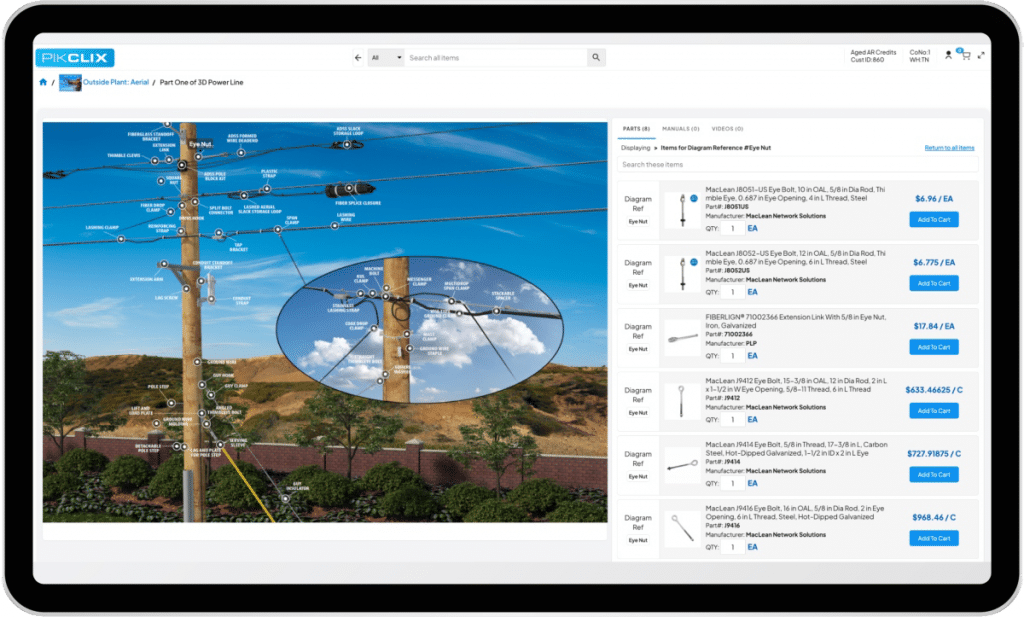
PikClix is removing a barrier that has always existed between a customer who knows what they need and a transaction that should be straightforward. When that barrier comes down, return rates fall, support calls fall, search time drops, and after-sales parts revenue, which most distributors leave significantly underdeveloped, becomes a more reliable channel.
The Discoverability Problem: When Good Data Stays Hidden
Most distributors have done real work to build quality product content. Accurate descriptions, complete specifications, current pricing. That work has real value, but only to the customers who find their way to the website. For the buyers who start their search on Google, the question is whether your products show up at all.
Google Merchant Center and similar channels offer meaningful reach to high-intent buyers who are actively searching for exactly what distributors sell. The barrier to capturing that traffic is not ambition. It is the operational complexity of maintaining a live, accurate product feed across channels that changes constantly as inventory moves, pricing updates, and new items are added.
Manual processes, typically some form of spreadsheet management, cannot keep pace. The result is stale data on Google, rejected listings flagged as unapproved, and a catalog that is effectively invisible to a significant portion of the buyer market.
|
Feed management sits in an uncomfortable middle ground organizationally. It is technical enough that marketing teams often cannot own it fully, but operational enough that IT does not prioritize it. The result is that nobody owns it well, and the spreadsheet approach becomes a permanent workaround rather than a temporary bridge.
The real cost is difficult to measure directly, which is part of why it persists. You can see a rejected listing, but the opportunity cost of the buyers who searched and found a competitor instead is invisible in the reporting.
The Solution: FusionX
FusionX connects your catalog to Google Merchant Center and other external channels through an automated, real-time data sync. Pricing and inventory updates flow from the platform outward, which means the information a buyer sees on Google reflects what is available. The Marketplace Connector interface gives internal teams direct visibility into feed status, flagging issues before they become rejections and providing the control that spreadsheet management could never offer.
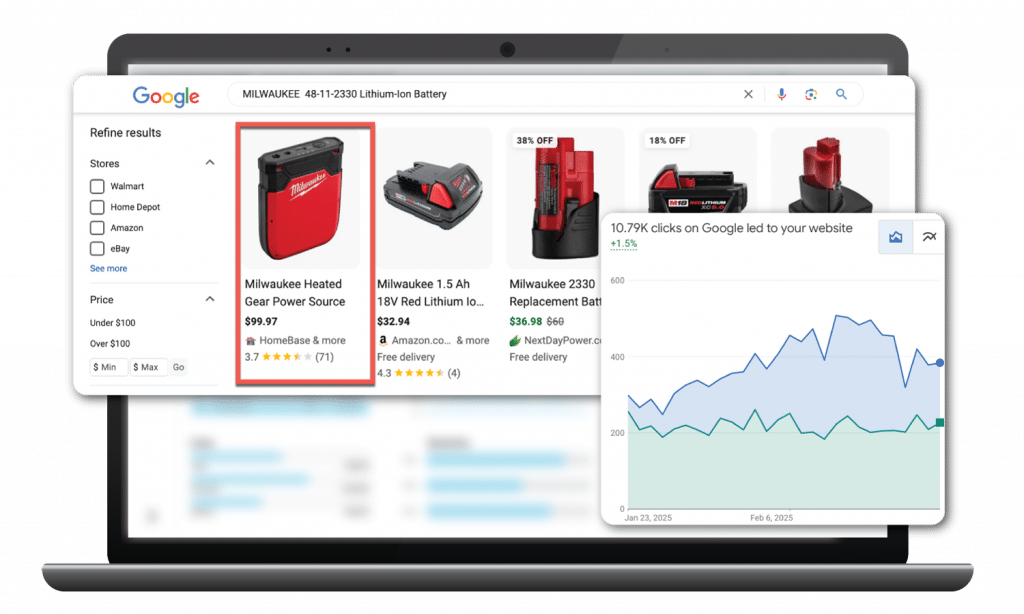
The underlying principle is that the work distributors do to maintain good product data should extend as far as possible, not terminate at the edge of their own website. Reach and accuracy are not competing priorities. With the right infrastructure, they reinforce each other.
The Intelligence Gap: Data That Exists, Insights That Do Not Reach the People Who Need Them
Modern eCommerce platforms generate substantial data about customer behavior. What products are being viewed. Which searches return no results. How customers navigate before they leave or before they convert. This data has real value for identifying selling opportunities, diagnosing friction, and understanding which online activity is likely to precede an offline purchase.
The problem is that almost none of it reaches the people in a distribution business who could act on it. Branch managers and sales reps are the individuals with the customer relationships and the context to follow up meaningfully on high-intent signals. They are also, almost universally, not the people interpreting GA4 dashboards.
The gap is not a training problem. It is a translation problem. Analytics platforms are built for analysts. Branch teams are built for selling. Those two things have rarely been connected in a way that produces consistent, actionable outcomes.
|
The intelligence gap persists because the tools for capturing data and the workflows for acting on it evolved separately. Analytics platforms were built for marketing teams and executives. Sales workflows were built around CRM systems and phone calls. The connection between a customer browsing your product pages at length and a sales rep picking up the phone the next morning has never had reliable infrastructure beneath it.
The Solution: GA4 Sales Assistant
The GA4 Sales Assistant addresses this by aggregating daily analytics and delivering branch-level summaries in plain language, directly to the inboxes of the people who can act on them. No dashboard access or interpretation required.
The insight that drives the design is straightforward: the value of analytics is not in the data itself, it is in the decisions the data enables. When a branch manager receives a morning summary highlighting which customers spent significant time on pricing pages the day before, that is a call that might otherwise never happen. At scale, across a multi-branch operation, those calls represent a meaningful and largely untapped revenue opportunity.

The Knowledge Problem: Technical Expertise That Does Not Scale
Distributors of complex products carry significant technical knowledge inside their organizations. That knowledge lives with experienced counter reps, application engineers, and product specialists who have spent years learning what their customers need and how the products work. It is a genuine competitive advantage, and it is almost entirely dependent on individual people being available.
Online, that advantage largely disappears. A customer on a product detail page at 8pm, trying to determine whether a component will work in their specific application, has no access to that institutional knowledge. They can read a spec sheet written for a general audience, or they can submit a contact form and wait. Neither outcome builds the confidence needed to complete a complex purchase.
This is not a small problem. Technical uncertainty is one of the primary reasons customers abandon purchases on complex product categories. The knowledge exists to resolve that uncertainty. The format in which it is typically delivered does not.
|
The knowledge problem persists because the traditional answer has always been more people: more technical reps, longer support hours, more detailed documentation. Each of those is expensive and limited in scale. The documentation-based answer in particular has a fundamental flaw: comprehensive documentation is written for completeness, not for the specific question a specific customer is asking right now.
The Solution: AI Tech Assistant
The AI Tech Assistant works by ingesting existing technical documentation and making it conversational. A customer asks a question in plain language and receives an answer drawn from the actual content of the relevant manuals, installation guides, and spec sheets. The response is grounded in the distributor’s own documentation, which means it reflects the accuracy and specificity that generic AI tools cannot provide.
The key design principle is that the solution should not require creating new content. Distributors have already done the hard work of building technical documentation. The AI Tech Assistant makes the existing assets work significantly harder by putting it in a format customers can use at the moment a purchase decision is being made.
The downstream effects are practical. Support call volume decreases for repeat technical questions. Customers complete purchases they would previously have abandoned or deferred. And the institutional knowledge that experienced staff have spent years developing gets extended across every product detail page, around the clock.
A Common Thread
Looking across these four problems, a pattern emerges. None of them are new. Parts ordering friction, disconnected product feeds, analytics that do not reach sales teams, and technical knowledge that does not scale have been real challenges in distribution for years. The technology to address them has not always been available in accessible, integrated form.
What ImpaqX has built is a set of solutions that are grounded in how distribution businesses actually operate. Not how they might operate in an idealized scenario, but the daily reality of branch managers, counter reps, marketing teams, and customers who need answers quickly.
|
The value of each product individually is real. The more important observation is what they represent together: a recognition that a well-implemented eCommerce platform is the beginning of a digital strategy, not the end of one. The distributors who close the gap between what their platform provides and what their business needs are the ones who will compete most effectively in the years ahead.