
Choosing an eCommerce partner is one of the most important decisions a company can make. The partner you select will shape how your customers interact with your business, how efficiently your team operates, and how well your digital strategy scales. Get it right, and your online channel becomes a growth engine. Get it wrong, and you risk wasted investment, poor adoption, and missed revenue opportunities. At Unilog, we’ve seen firsthand how the right partnership can transform a distributor’s business. This guide walks you through how to evaluate, compare, and ultimately choose the eCommerce partner that fits your organization—one that understands your goals, your systems, your content, and the way your buyers do business.

Understanding the eCommerce Partner Landscape
Types of eCommerce Partners and Service Models
When you begin researching eCommerce partners, you’ll notice three main categories:
Platform providers offer the eCommerce software itself. They usually sell licenses or subscriptions and may rely on implementation partners for setup. The benefit is a reliable roadmap and robust technology foundation, but you may need additional partners to fill gaps in design, data management, or product content.
Agencies and system integrators (SIs) focus on implementation, design, and integrations. They’re often flexible and creative but depend on third-party platforms, which can add complexity and cost.
Full-service partners combine technology, implementation, content, and ongoing support. This “all-in-one” model simplifies management and accountability, provided the partner is equally strong across all areas.
Beyond the type of partner, consider the delivery model that fits your organization:
- SaaS (Software-as-a-Service) solutions are cloud-based and easy to update, offering predictable costs and frequent improvements.
- On-premise platforms provide full control but demand significant internal IT resources.
- Hybrid setups combine both approaches, often chosen by companies with specific compliance or integration requirements.
Finally, seek out partners with B2B specialization. Many eCommerce platforms were built for retail and lack critical functionality like contract pricing, approval workflows, account hierarchies, and integrated product content. A true B2B partner includes these from day one, helping you fill your digital shelves with the right products, attributes, and data to meet buyer expectations.
Why the Right eCommerce Partner Matters
Choosing an eCommerce partner isn’t just about launching a website—it’s about aligning your technology, content, and strategy for growth. A strong partner helps you turn business goals into digital outcomes—like faster quote-to-cash cycles, higher online adoption, and measurable ROI.
Think beyond software features. You’re selecting a long-term ally who will evolve with your business, support your data and content strategy, and help your teams deliver consistent, high-value digital experiences.

Defining Your eCommerce Requirements
Before you evaluate platforms or partners, you need a clear understanding of what success looks like for your business.
Assess Current and Future eCommerce Needs
Start by defining your vision for eCommerce. Do you want to increase online revenue, drive more self-service orders, or reduce manual quote processing? Clarifying your goals shapes every other decision.
Research from TrustRadius shows that 87% of B2B buyers want to self-serve for part or all of their purchasing journey. Your eCommerce partner should enable that experience through intuitive UX, integrated product content, and seamless backend connections that make it easy for buyers to find and trust what they’re purchasing.
Next, think ahead. Are you expanding into new regions, adding product lines, or creating new buying experiences like mobile ordering or marketplaces? A partner who understands your growth trajectory can recommend a platform that scales with you instead of one you’ll outgrow.
Finally, map out your internal stakeholders and resources. Identify who owns product content, ERP integration, and digital strategy. When these roles are clearly defined, your partner can engage the right people at the right time, keeping your project on schedule.
Evaluate eCommerce Technical Requirements
Technology is where strong partnerships either shine or stumble. Look for partners who can support the specific needs of B2B businesses, including:
- Contract and tiered pricing, account hierarchies, and approval workflows
- Rich, accurate product content that can be updated automatically as manufacturers release new data
- Powerful search that supports attributes, synonyms, and large catalogs
- Real-time ERP integration for pricing, inventory, and order visibility
- Extensible APIs that allow for customization and future growth
- Mobile responsiveness and accessibility compliance
Your product content deserves special attention—it’s the foundation of every online interaction. When buyers can quickly find detailed specs, clear descriptions, and up-to-date images, they’re more likely to complete a purchase. The right eCommerce partner understands how product content and commerce work together to drive conversions.
Plan for Budget and Resources
Budgeting for eCommerce isn’t only about licensing fees. Include costs for implementation, integrations, content enrichment, UX design, data migration, SEO setup, and ongoing optimization. Many organizations underestimate internal workload and end up short-staffed mid-project.
The best partners will help you anticipate internal demands and build a realistic project plan. They’ll work with your team to create a sustainable balance between what you manage in-house and what they support long term.
Additionally, look for platforms with native AI capabilities that streamline everyday work. Leading eCommerce solutions are now embedding AI tools that help teams move faster and smarter—automating repetitive tasks like blog writing, search refinement, SKU enrichment, and even sales insights. These capabilities not only save time but also improve accuracy and consistency across your digital operations. Choosing a partner with built-in AI functionality means your team can focus more on strategy and customer experience while the technology handles the heavy lifting behind the scenes.

Essential Selection Criteria for eCommerce Partners
Once you know what you need, it’s time to evaluate potential partners. These criteria will help you compare both technology and service quality.
eCommerce Platform Capabilities
When evaluating eCommerce platforms, move beyond feature checklists. Ask how well the system supports your real workflows and content operations. Can it manage complex pricing, multi-location inventory, and multi-site catalogs? Does it also make it easy to manage and update large volumes of product content?
The best eCommerce partners help you connect technology and data. They recognize that a seamless buyer experience starts with clean, consistent product content—searchable, shoppable, and ready for every digital channel.
eCommerce Integration Strength
Integration determines how seamlessly your digital operations function day to day. Look for partners that treat integration as a core competency, not an afterthought.
Ask how their platform connects with your ERP, PIM, CRM, and fulfillment systems. Evaluate their approach to data synchronization, API documentation, and error handling. Companies with tight ERP and eCommerce integration often see higher order-processing efficiency and fewer order-processing errors.
A capable partner won’t just describe integration—they’ll show you proven patterns and examples from similar clients.
eCommerce Implementation and Support
Implementation reveals how mature and reliable a partner truly is. Strong partners start with a minimal viable product (MVP), validate success, and scale from there. They emphasize training, documentation, and post-launch support so your team can manage confidently.
Ask about update processes and service-level agreements (SLAs). You want a partner invested in your success long after launch—not one that hands off the project and disappears.
Industry Experience and Expertise
Technology is important, but expertise drives execution. Does your potential partner understand distribution, manufacturing, or showroom operations? Can they show measurable outcomes from companies like yours?
A partner fluent in your industry anticipates roadblocks, aligns digital strategy with real-world workflows, and delivers faster ROI.
The eCommerce Partner Selection Process
Create a Structured Evaluation Framework
A structured evaluation process reduces bias and ensures transparency. Create a scoring model that weights categories such as platform (30%), integrations (30%), services (25%), and experience (15%).
Invite cross-functional stakeholders—from IT and operations to marketing and sales. Teams that collaborate in vendor selection report significantly higher satisfaction with their final choice.
Run a Smart RFP
A thoughtful RFP reveals how a potential partner communicates and solves problems. Instead of generic yes/no questions, describe your real business scenarios: multi-warehouse inventory, contract pricing, or quote approvals.
Request architecture diagrams, implementation timelines, and sample statements of work. Avoid vendors who rely on heavy custom coding for basic functionality or give vague answers about integrations.
Common PIM Implementation Scenarios
Typical scenarios include launching or relaunching eCommerce, consolidating fragmented product sources, onboarding large supplier assortments quickly, and establishing attribute governance for complex lines. PIM provides the framework to execute each scenario predictably, with clear roles and quality thresholds.
Evaluate Demos and Proofs of Concept
Treat demos like real-world tests, not presentations. Provide your actual data, product structures, and workflows. Observe how each partner’s solution handles your complexity.
Does it process orders accurately? Can users find what they need easily? Integrate with your ERP? A partner’s ability to deliver these details under realistic conditions often predicts long-term success.
Doing Your Due Diligence
Before signing, confirm that what you’ve been told matches reality.
Check References
Reference checks are a powerful validation tool. Speak with current and former clients—especially those who encountered mid-project challenges. Ask about transparency, responsiveness, and post-launch support.
Look for consistent themes. If several customers mention the same concern, take it seriously. You can also tap your buying group or professional networks for candid feedback from peers.
Verify Security and Compliance
Your partner’s approach to security should be well-defined and well-documented. Confirm encryption standards, single sign-on (SSO) capabilities, and audit logging. Request proof of compliance certifications such as SOC 2, PCI, or ISO.
Also clarify data ownership and portability. If your business ever changes platforms, you’ll want assurance that your data—including enriched product content—can migrate easily and safely.

Making the Final Decision
Balance Technical and Business Factors
Once scoring is complete, step back to evaluate the big picture. A technically strong platform might not be the best cultural or operational fit. Likewise, a smaller partner with deep industry expertise might outperform a larger vendor on responsiveness and alignment.
Document the trade-offs and review them with your stakeholders. This transparency prevents surprises later and builds organizational buy-in.
Negotiate Contracts and SLAs
Your contract sets expectations for the entire relationship. Define acceptance criteria, change control procedures, and escalation paths. Review uptime and response commitments carefully, and ensure the exit clause protects your access to both data and product content.
The right partner treats contracts as a roadmap for collaboration, not confrontation.
Setting Up for eCommerce Implementation Success
Even after selection, execution determines success.
Transition Planning
Smooth transitions require coordination between multiple teams—product content, IT, UX, and marketing. Establish clear milestones for data migration, ERP connections, testing, and training. Build buffer time for performance checks before launch.
Partners that guide this process collaboratively give your team confidence and help minimize disruption when the site goes live.
Change Management and Adoption
Technology only succeeds when people use it. Communicate early and often about the “why” behind the new system. Provide role-specific training and track adoption metrics like online order percentage, quote-to-order conversion, and repeat visits.
Companies that measure adoption consistently see stronger ROI and higher average order values post-launch. A strong partner will help you monitor these indicators and adjust strategies as your business evolves.
Your eCommerce Partner Selection Worksheet
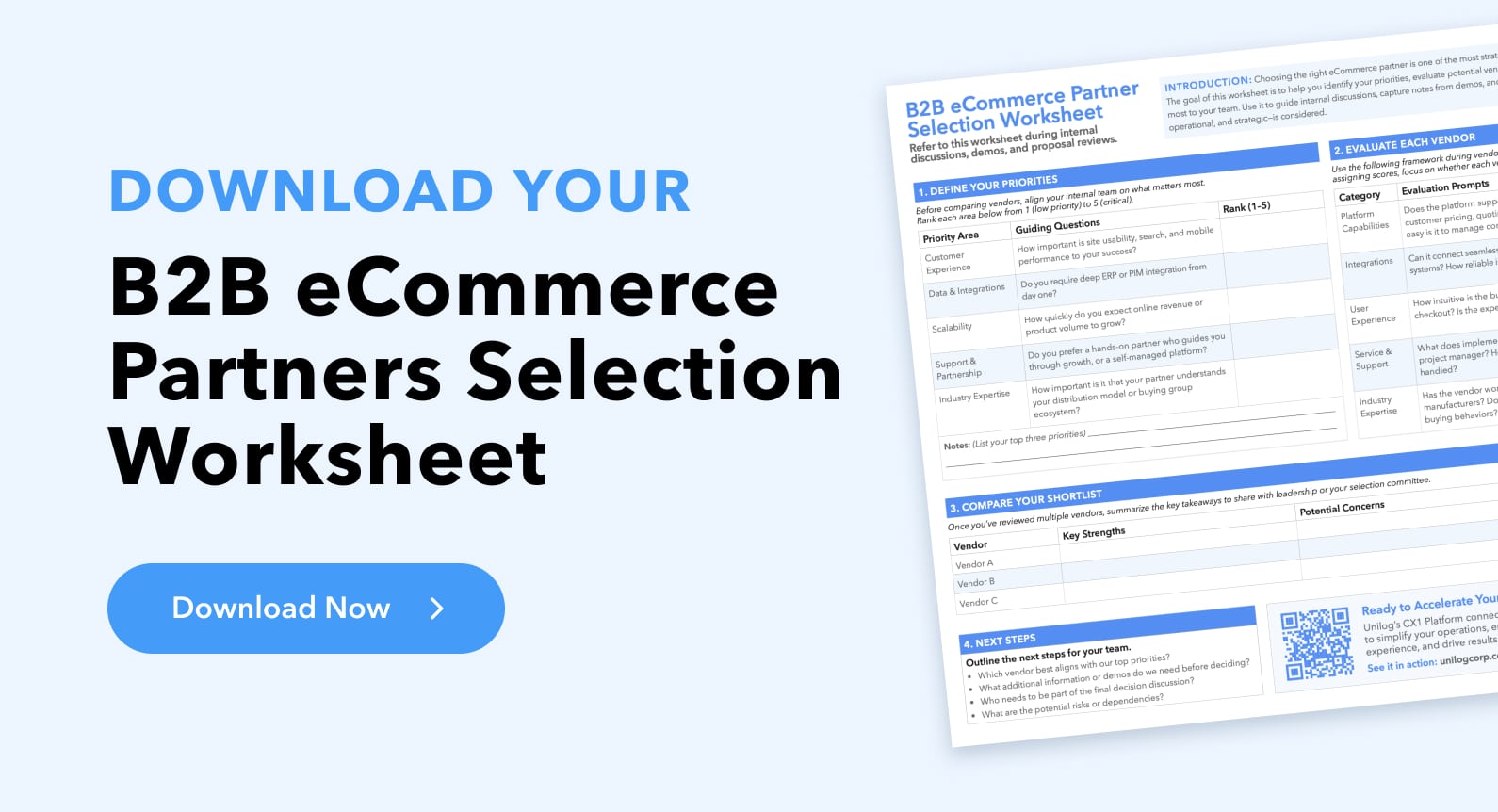
To make your evaluation process easier, Unilog has created a downloadable worksheet that lets you score potential partners across platform capabilities, integrations, services, and experience.
Where Unilog Fits
Unilog’s CX1 Platform brings together connected product content and eCommerce capabilities purpose-built for distributors and manufacturers. We don’t just provide technology—we provide partnership.
With CX1 eCommerce products, distributors and showrooms can fill their digital shelves with rich, accurate, and always up-to-date product content. Our integrated content services connect directly to thousands of manufacturer data sources, ensuring buyers always see detailed specs, images, and descriptions that build confidence and drive conversions.
Beyond content, the CX1 Platform delivers advanced B2B functionality, seamless ERP integrations, and continuous innovation. Our team works alongside yours to implement, optimize, and continually enhance your digital operations so you see measurable results: faster quote-to-cash cycles, stronger online adoption, and improved margins.
If you’re evaluating eCommerce partners, let’s talk. Schedule a consultation with Unilog’s experts or explore our customer success stories to see how distributors like you are achieving measurable digital growth.